CRO
Does seeing the model sell the suit?
At EchoLogyx, I ran a suiting test for a UK fashion retailer. Model photos lifted revenue per visitor by 50%.
Overview The short version
I did this at EchoLogyx, for a UK fashion retailer. Suiting category pages led with hanger shots. Most fashion sites do the same. Suits are harder to judge that way. Fit, shoulder line, and how the cloth hangs are hard to see from a flat photo.
I ran an A/B test on six suiting collections. Convert called it Model vs Product Image. Variation 1 turned on the store’s Model view toggle. The first tile image became a model shot. Copy, layout, and everything else stayed the same. One change: the photo.
The test ran for 29 days, 17 Apr - 15 May 2026. 14,115 people saw it, split 50/50.
Hypothesis Why I ran this test
I wanted a straight answer. On suiting pages, does a model photo as the first image beat a product-only photo?
If a model wearing the suit is the first image, more people will look and buy, because they can see the fit and how it looks on a body.
A t-shirt is easy to guess. A suit is not. You cannot tell from a hanger how a jacket sits on the shoulders, or how the trousers break at the ankle. A model photo answers that in a second.
Pages in this test: suits, blazers, tailored trousers, linen suits, single-breasted suits, and double-breasted suits.
Test setup What I changed
Two versions. Same six pages. Traffic split evenly. Convert sent all visitors into the test. The only change was the first image on the product tile, using the store's Model view toggle. Off for control. On for the variation. Same products, same layout, same copy.
If you want the setup rather than the result, I wrote up how to wire Convert into Shopify separately.
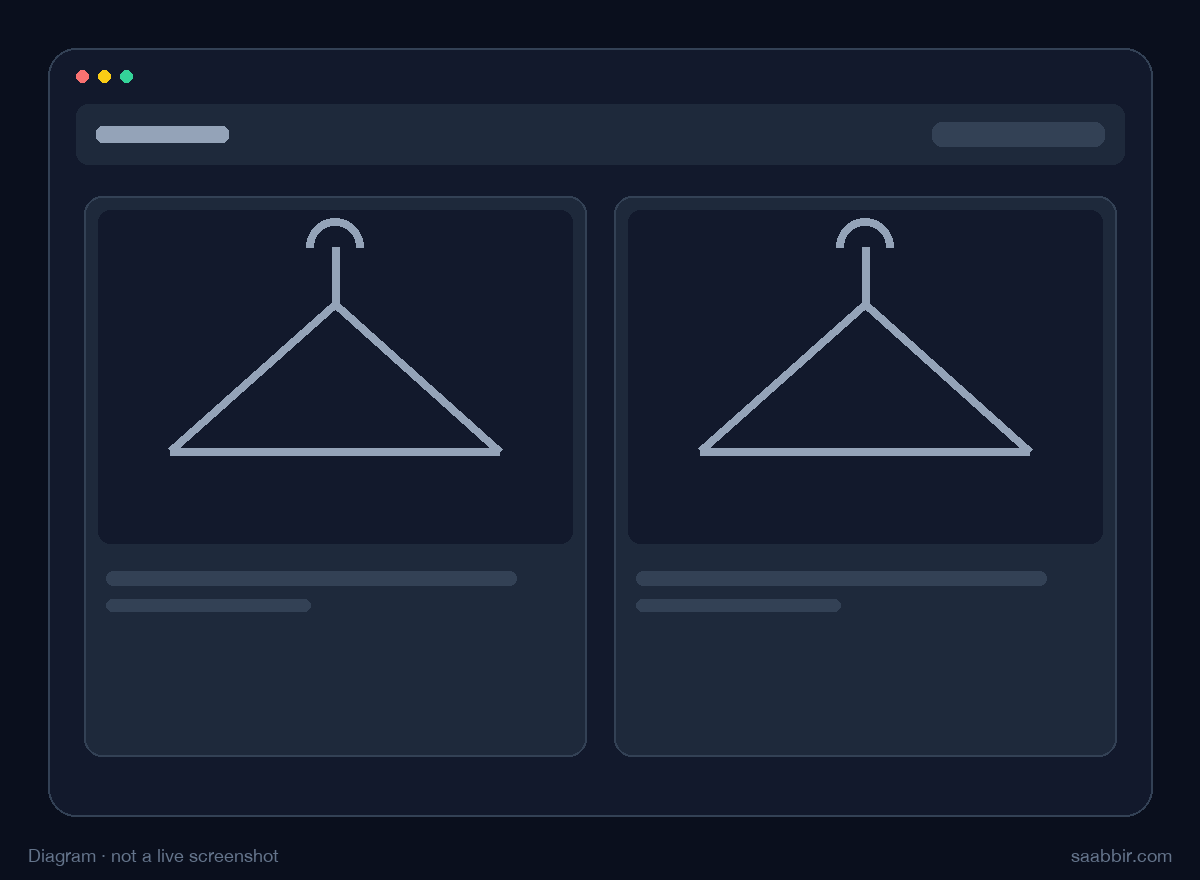
Control · Model view off
Hanger photos
The original page. Jackets on hangers as the first tile image. Clean and consistent, but no sense of fit or styling.

Variation 1 · Model view on
Model photos
Same products, shown on a person. You can see the fit, the drape, and how the jacket is worn. Nothing else on the page changed.
Results What happened
After 29 days and 14,115 visitors, Variation 1 made more money per visitor, converted more, and put more items in the basket. People did not click more tiles on the listing. The gain showed up later: more checkouts, more items, more revenue.
Currency amounts are not published. Revenue per visitor reached 98.18% confidence. Products per visitor reached 99.29%. Purchase rate was 92.55%, so close to the usual 95% bar, but not over it. Listing clicks were flat (27.6% confidence). These figures come from Convert's main Purchase goal.
Insights What this tells a fashion store
Seeing the fit helped people buy
Purchase rate went from 3.36% to 3.97%. Revenue per visitor went up 50%. A model shot shows shape and styling in a way a hanger cannot.
Baskets got bigger
Average order value went up 24%. Items per order went from 2.33 to 2.97. That looks like people building an outfit, not grabbing one piece.
The win was not more listing clicks
Tile clicks were flat. Product page views were slightly down. The extra money did not come from more people opening products. It came from what they did after they arrived: more checkout, more items, more spend. Those who opened a product also scrolled further.
Bounce rate did not get worse
Bounce went from 88.69% to 88.20%. That is basically unchanged. An early snapshot made bounce look like a risk. The finished data does not.
Caveats What this does not prove
Purchase rate is not at 95% confidence. Convert gives purchase rate 92.55%, revenue per visitor 98.18%, and products per visitor 99.29%. The money story lines up, but 235 vs 283 purchases is still the noisier number.
This is suiting only. 14,115 visitors is a fair sample for this category. The same photo swap may not work on t-shirts, knitwear, or belts, where fit is less of a question.
It ran in spring. 17 Apr - 15 May 2026 sits in suiting and linen season. The percentage lifts are not a yearly forecast.
Convert had two purchase goals. The main Purchase goal shows revenue per visitor up 50.28%. A manual purchase goal shows a smaller lift, 19.45% at 81.49% confidence, with almost no change in order value. Both favour Variation 1. This write-up uses the main goal.
Takeaway What this means
A one-photo change made suiting pages more valuable
Revenue per visitor, products per visitor, and 100% product-page scroll all cleared 95% confidence for the model photo. Purchase rate and begin checkout move the same way. Listing clicks did not need to rise for revenue to rise.
Who this helps
Fashion stores that lead with hanger shots on clothes where fit, drape, and styling matter. Suiting is the clear example. Shirts and tailoring often have the same question.
What I'd watch next
Whether the same photo swap holds on shirts and tailoring, where fit still matters but the category is less seasonal than linen suiting.
Work with us
Need help with something like this?
Need help with A/B testing, Shopify development, or a performance audit? Reach out to EchoLogyx.